
Blog > Ethics Is a Talking Point in Real Estate : By Ken Alger, REALTOR®
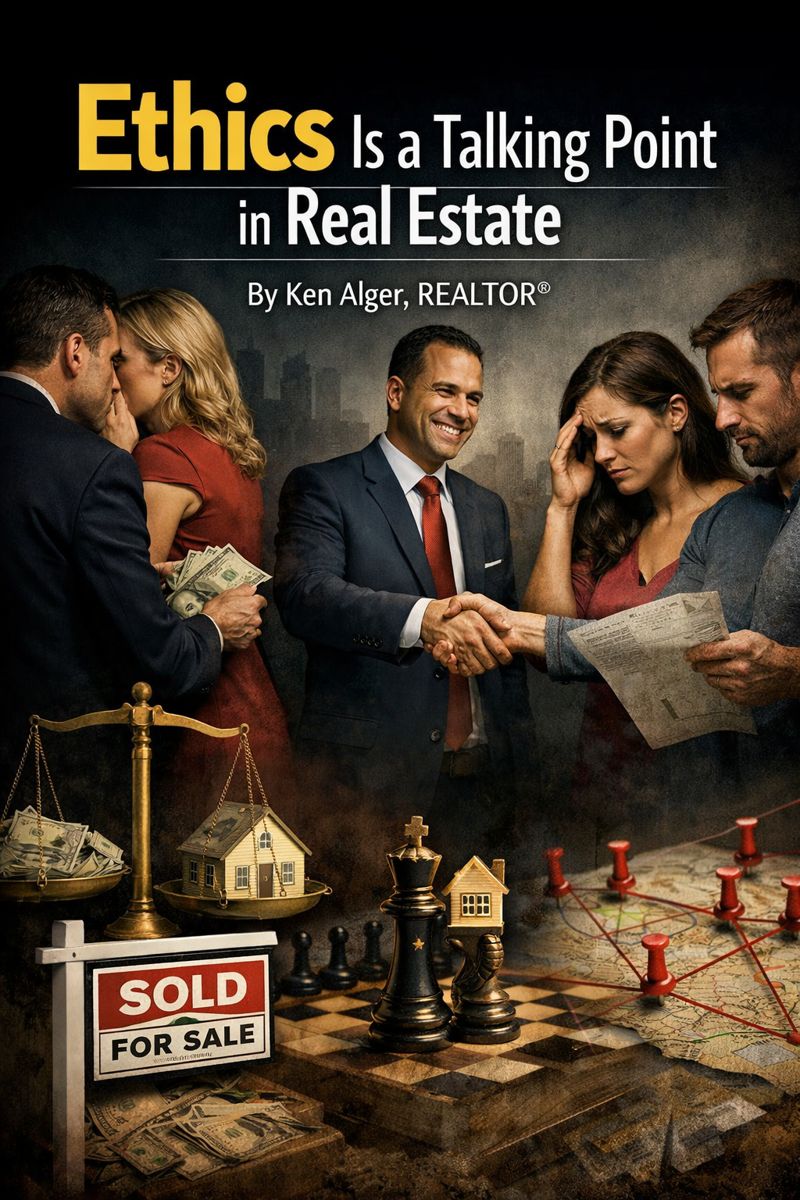
Ethics Is a Talking Point in Real Estate
By Ken Alger, REALTOR®
Ethics is one of the most overused words in real estate—and one of the least practiced.
Every brokerage website has a page about “values.” Every top producer panel opens with a nod to “doing the right thing.” Every trade organization proudly references a Code of Ethics. Yet consumers across Minnesota—and across the country—continue to experience pressure, manipulation, discrimination, and steering at alarming rates.
This article is not about bad apples.
It is about incentives.
And incentives explain behavior far better than mission statements ever will.
Ethics as Branding, Not Behavior
In modern real estate, ethics has been reduced to a branding device.
Large brokerages and high-volume producers talk about ethics because it reassures consumers. It lowers friction. It builds trust just long enough to move someone into a transaction. But once that transaction is in motion, ethical language often disappears—replaced by urgency, fear, and subtle coercion.
“Just sign now.”
“You’ll lose the house if you wait.”
“This is how it’s done.”
“Everyone does it this way.”
None of those phrases protect consumers. They protect throughput.
When your business model depends on volume, speed matters more than accuracy. Human beings stop being people and start becoming units of production—leads, files, closings, sides.
That is not a moral failing of individuals.
It is the predictable outcome of scale without accountability.

The Commodity Mindset
Top producers do not get there by accident. They get there by optimizing systems—scripts, funnels, pipelines, referral engines, team structures. These systems are incredibly effective at converting activity into income.
They are far less effective at protecting consumer autonomy.
When success is measured primarily by units closed, people become interchangeable. Buyers become “motivated.” Sellers become “inventory.” Renters become “waste.” First-time buyers become “education heavy.” Complex situations become “time sucks.”
The language tells the story.
Ethical practice requires slowing down. It requires saying no. It requires advising against a transaction when it benefits the client but costs the agent.
High-volume systems punish that behavior.
Pressure Disguised as Professionalism
One of the most common ethical violations in real estate is not fraud. It is pressure.
Pressure to waive inspections.
Pressure to escalate offers beyond comfort.
Pressure to list before ready.
Pressure to accept terms “because the market says so.”
This pressure is rarely overt. It is framed as expertise.
Consumers are told that hesitation is ignorance. That caution is fear. That asking questions means they are “not serious.” And because agents hold asymmetric information—contracts, norms, market access—that pressure works.
Especially on first-time buyers.
Especially on marginalized communities.
Especially on people who have been historically excluded from wealth-building opportunities.
That is not accidental. That is structural.
Steering Didn’t Go Away—It Got Quieter
Steering is illegal. It is also still common.
It no longer looks like explicit red lines on maps. It looks like “helpful suggestions.” It looks like which listings are shown first. It looks like how neighborhoods are described—or avoided. It looks like silence.
Large brokerages rarely train agents to confront this honestly. Why would they? Steering reduces friction. It keeps transactions “smooth.” It avoids uncomfortable conversations about race, class, disability, immigration status, or family structure.
Ethics training often focuses on avoiding lawsuits—not on dismantling bias.
That distinction matters.

Why Big Brokers Struggle With Ethics
Large brokerages are not evil. They are bureaucratic.
They rely on scale, brand protection, and legal insulation. When ethical issues arise, the priority is containment—not correction. Complaints are routed to compliance departments. Language is softened. Patterns are ignored unless they create liability.
Top producers are rarely disciplined. They generate too much revenue.
This creates a two-tier ethical system:
-
One set of rules for new agents
-
Another for rainmakers
Consumers feel this imbalance instinctively—even if they cannot articulate it.
What Ethical Real Estate Actually Looks Like
Real ethics in real estate is not loud. It is inconvenient.
It looks like:
-
Advising a buyer not to buy when the numbers don’t work
-
Telling a seller their expectations are unrealistic
-
Explaining options slowly, even when it costs time
-
Documenting conversations instead of rushing signatures
-
Respecting a client’s pace, even when it risks the deal
-
Refusing to participate in discriminatory practices, even quietly
Ethics is not neutral.
It costs something.
If it doesn’t cost you time, money, or comfort, it probably isn’t ethics—it’s marketing.

The Consumer Takeaway
If an agent:
-
Rushes you
-
Dismisses your questions
-
Minimizes your concerns
-
Frames urgency as expertise
-
Treats your transaction like a unit instead of a decision
That is not professionalism.
That is production pressure.
You are not a commodity.
Your home is not a metric.
Your future is not a quota.
Ethics in real estate does not enforce itself. It works only when consumers recognize the difference between ethical language and ethical behavior—and choose professionals who prove the latter.
A Final Word to the Industry
If ethics is only something you talk about when it is convenient, you are not ethical.
You are efficient.
And consumers are finally learning the difference.
If you want to talk about this—or if you want an agent who treats decisions like decisions, not inventory—I’m easy to find.