

Blog > I’m Not Political the Way You Think I Am Why Rejecting False Choices Matters More Than Picking Sides: By Ken Alger, REALTOR®
I’m Not Political the Way You Think I Am Why Rejecting False Choices Matters More Than Picking Sides: By Ken Alger, REALTOR®
by
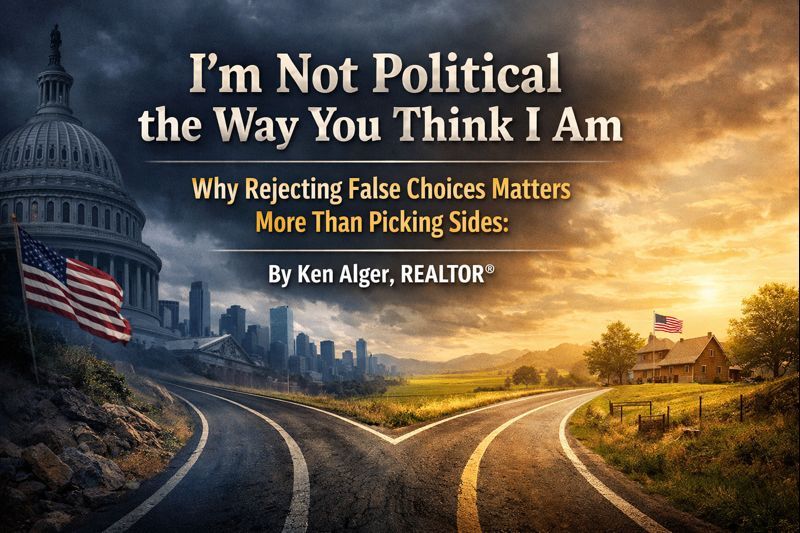
I’m Not Political the Way You Think I Am
Why Rejecting False Choices Matters More Than Picking Sides:
By Ken Alger, REALTOR®
People think they understand my politics because they recognize pieces of my views.
If I talk about housing inequity, historic discrimination, or social responsibility, I must be a Democrat.
If I criticize corporate capitalism, I must be a socialist.
If I refuse to pledge loyalty to a party, I must be disengaged.
None of that is accurate.
What actually makes people uncomfortable is that I don’t operate inside political binaries. I reject them entirely.
I Reject False Dichotomies
America is addicted to black-and-white thinking.
Big government or small government.
Left or right.
Us or them.
Those aren’t serious frameworks. They’re psychological shortcuts, and they’ve done enormous damage.
I believe you can support big government and small government at the same time, because reality demands it.
Some problems require centralized power, coordination, and scale.
Others require decentralization, local control, and flexibility.
Thinking otherwise isn’t principled. It’s irresponsible.
Infrastructure, environmental protection, civil rights enforcement, and market regulation require strong federal capacity. Local governance, land use, education models, and community-specific solutions often require less centralized control and more state or regional autonomy.
Both can be true at once.
The insistence that you must choose one or the other is not ideology. It’s intellectual laziness.

Black-and-White Thinking Is a Logical Failure
False dichotomies are a logical fallacy, and they dominate American political thinking.
People are trained—deliberately—to believe there are only two options. Once you accept that premise, you stop evaluating ideas on their merits and start defending identities instead.
Most people aren’t reasoning. They’re operating on confirmation bias.
They seek information that reinforces what they already believe. When confronted with evidence that challenges those beliefs, they don’t reassess—they entrench. Not because the evidence is weak, but because abandoning a binary feels like losing part of themselves.
I don’t accept that mode of thinking.
I was once told: stop staring at the features of the picture—zoom out and look at the whole image.
Most people never zoom out. They fixate on what validates them and ignore everything else.
That isn’t insight. It’s conditioning.
I Reject Political Identity Altogether
I am not liberal.
I am not conservative.
I do not vote.
That last sentence unsettles people, but it shouldn’t.
I don’t abstain because I’m apathetic. I abstain because I refuse to participate in a system that prioritizes ritual over understanding.
The American political system does not function the way it is taught. It functions as a corporate-captured structure that depends on emotional branding, simplified narratives, and an underinformed electorate.
Voting has become a psychological release valve. People are told that if they vote, they’ve done their part—even if they don’t know how legislation is written, how committees operate, or how regulatory agencies are influenced once elections are over.
That isn’t civic engagement. It’s performance.
If you don’t understand legislative process, committee power, regulatory capture, or the role of money in policymaking, voting is not participation. It’s consumption.
Requiring a few hours of C-SPAN a year before voting wouldn’t be radical. It would be baseline civic literacy.
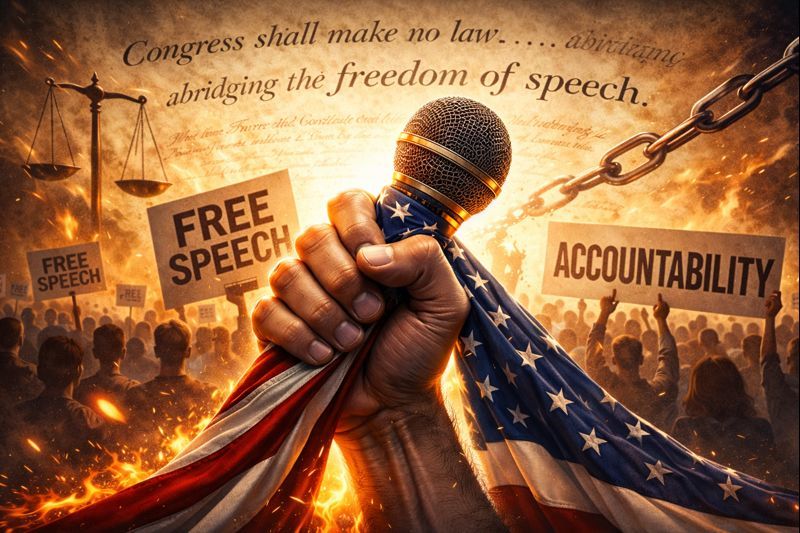
I Am Radically Pro–First Amendment
I believe in free speech. All of it.
You should be allowed to say whatever you want.
And you should be fully accountable for the consequences of saying it.
Those ideas are not opposites. They are inseparable.
Speech without consequence is entitlement. Consequence without speech is authoritarianism. What many people want now is insulation from accountability while demanding restrictions on speech they dislike.
I don’t operate that way.
I speak clearly. I take positions. I accept the outcomes. That includes criticism, disagreement, and lost opportunities. Clarity matters more than approval.
My Second Amendment Views Are Intentionally Extreme
This is where most political sorting breaks down.
I do not believe in firearm restrictions.
I do not believe gun laws meaningfully prevent violence.
I believe that if you can afford it, you should be able to own it.
Tank. Helicopter. Fully automatic weapons.
If you have the means, the responsibility is yours.
Most mass violence in this country is committed with legally obtained firearms. The idea that incremental restrictions solve cultural, psychological, or social collapse is comforting, but largely unsupported in reality.
Gun control looks clean on paper. In practice, it repeatedly fails to address root causes while offering the illusion of action.
I understand the argument. I reject the outcome.
I Reject Corporate Capitalism—Not Wealth
This distinction is essential.
I believe in wealth creation.
I believe in ownership.
I believe people should be free to build and use capital.
What I reject is corporate capitalism—the system where corporations quietly function as an unacknowledged branch of government, shaping legislation, influencing regulators, distorting housing markets, and avoiding accountability.
Pretending corporations aren’t governing forces is dishonest.
If we were serious about transparency, corporations would have their own explicit branch of government—clearly defined and clearly constrained.
Between that corporate branch and the people’s government, there would need to be a third, neutral structure, composed of both sides, tasked with resolving conflicts where profit and public harm collide.
That body wouldn’t exist to protect profit or placate voters. It would exist to prevent damage.
If a tie must be broken, it should favor the people—not sentimentally, but because government is supposed to serve them. The fact that this sounds unrealistic says everything about the current system.

Eurocentric History, Native Land, and the Comfort of Forgetting
I don’t believe in symbolic acknowledgments without material change.
I don’t believe in diversity language without restitution.
I don’t believe in rewriting history to make colonization sound inevitable.
I believe land should be returned to Native nations. Not rhetorically. Not eventually. Actually returned.
People say this and don’t mean it. I do.
Real estate—land ownership itself—is one of the clearest continuations of dispossession in this country. You cannot talk honestly about housing, zoning, wealth accumulation, or property rights without confronting that reality.
White history in the United States has been carefully curated to avoid discomfort. Native history has been minimized, distorted, or sidelined. That selective memory still shapes markets, access, and policy today.
Ignoring that isn’t neutrality.