

Blog > The Truth About Native American Warfare in the United States By: Ken Alger, REALTOR®
The Truth About Native American Warfare in the United States By: Ken Alger, REALTOR®
by
The Truth About Native American Warfare in the United States
By: Ken Alger, REALTOR®
Most Americans believe they understand Native American warfare, but what they actually understand is a narrow myth built almost entirely through a European lens. That lens assumes war is inherently about domination, total victory, and the destruction of an enemy’s ability to exist. When that framework is applied retroactively to Indigenous societies across what is now the United States, it produces conclusions that are not merely inaccurate, but structurally dishonest. Native warfare is then mischaracterized as primitive, chaotic, or brutally instinctual—when in reality, it was often governed by rules, ethics, and strategic limits that Europeans themselves had long abandoned.
This misunderstanding did not happen by accident. It emerged from colonial necessity. To justify conquest, displacement, and extermination, European powers needed Native societies to appear violent in a way that mirrored European violence—while stripping away the context, constraints, and cultural logic that made Indigenous warfare fundamentally different. What Americans inherited was not history, but a moral alibi.
European Warfare and the Projection of Total War
European warfare, especially after the medieval period, increasingly moved toward what historians now call total war. Civilian populations were no longer protected by custom or theology, and the line between combatant and noncombatant was routinely crossed whenever it produced advantage. Crops, homes, and entire towns became legitimate targets, not because they posed immediate military threats, but because destroying them weakened future resistance. Violence became industrial, scalable, and morally abstracted, particularly as empires expanded beyond Europe.
When Europeans encountered Native nations, they did not attempt to understand Indigenous approaches to conflict on their own terms. Instead, they assumed all warfare followed the same logic they already knew, and they treated any difference as inferiority or deceit. When Native groups practiced restraint, Europeans often interpreted it as either weakness or evidence of irrational cruelty, depending on which storyline best justified the land grab at the moment. The possibility that Indigenous warfare could be intentionally bounded—strategic without being exterminatory—did not fit the colonial script, so it was flattened out of the record.
Indigenous warfare in the United States was shaped by place, resource cycles, kinship systems, spiritual obligations, diplomacy networks, and the hard fact that communities had to keep functioning after conflict ended. That reality naturally discouraged permanent, unlimited destruction, because a world where war never ends is a world where trade collapses, alliances break, and survival becomes impossible. This is why so many Indigenous conflict systems focused on deterrence, restitution, and balance rather than elimination. Europeans, however, carried a model that treated elimination as a legitimate endpoint, and they projected that model onto everyone else.
What Native American Warfare Was Actually For
A major reason this topic gets mangled is that people assume war has one purpose: to conquer and control territory permanently. In many Native nations, warfare was often about maintaining equilibrium within a regional system rather than building empires in the European style. That doesn’t mean there were no territorial disputes or no ambitions; it means those ambitions operated inside cultural constraints that mattered. Honor, reciprocity, clan obligations, and spiritual boundaries frequently shaped what was considered acceptable, even in violent circumstances.
Across the United States, Indigenous warfare commonly served purposes like retaliation, deterrence, recovering losses, enforcing boundaries, or addressing specific grievances that diplomacy could not resolve. Conflicts could be intense and deadly, but they were often bounded by rules that maintained the possibility of future coexistence. That bounded nature is precisely what Europeans misunderstood or refused to acknowledge. To a colonizer who wants your land, the idea that you fight for a limited reason rather than for total destruction is not “civilized”—it’s inconvenient.
Native warfare was also deeply shaped by the environment. Open plains, dense forests, swamps, deserts, coastlines, and mountain corridors produce radically different tactical realities, and Native nations adapted to each with sophistication that modern readers should respect. The United States is not one battlefield. It’s a continent of battlefields, each with its own logic, and Indigenous warfare reflected that diversity.
The Plains Nations: Visible in History, Still Misread
Plains warfare is the image most Americans carry because it collided directly with westward expansion and was documented heavily by U.S. military sources, settler accounts, and later popular media. Nations such as the Lakota, Cheyenne, Comanche, Arapaho, and Kiowa built warfare systems that were mobile, intelligence-driven, and exceptionally effective across wide territory. The horse transformed the Plains, but it did not create “savagery”; it created speed, reach, and strategic flexibility. That is why Plains nations were such formidable opponents, and why the U.S. military treated them as a serious threat rather than a minor obstacle.
Plains warfare frequently emphasized raids, skill demonstrations, and tactical strikes rather than mass slaughter. A core example is “counting coup,” where bravery and status could be earned by touching an enemy and escaping rather than killing them. That practice directly challenges the European assumption that the point of warfare is maximum death. It demonstrates that courage, restraint, and social recognition could matter as much as lethality.
This is also where Europeans and Americans often confuse “effective” with “inhuman.” Plains tactics—hit-and-run strikes, feints, dispersed movement, rapid regrouping—made European formations look rigid and slow. When a culture loses control of the narrative, it tends to rename what beats it as barbarism. Much of what Americans were taught about Plains warfare is exactly that: a narrative defense mechanism.
Common Plains warfare realities people miss:
-
Raiding often targeted resources and horses more than bodies.
-
Large set-piece battles were not the default; mobility was the advantage.
-
Warfare was interwoven with diplomacy, alliances, and regional balance.
-
Noncombatant targeting was not automatically normalized in the way Europeans practiced it.
The Eastern Woodlands: Confederation, Fortification, and Political Warfare
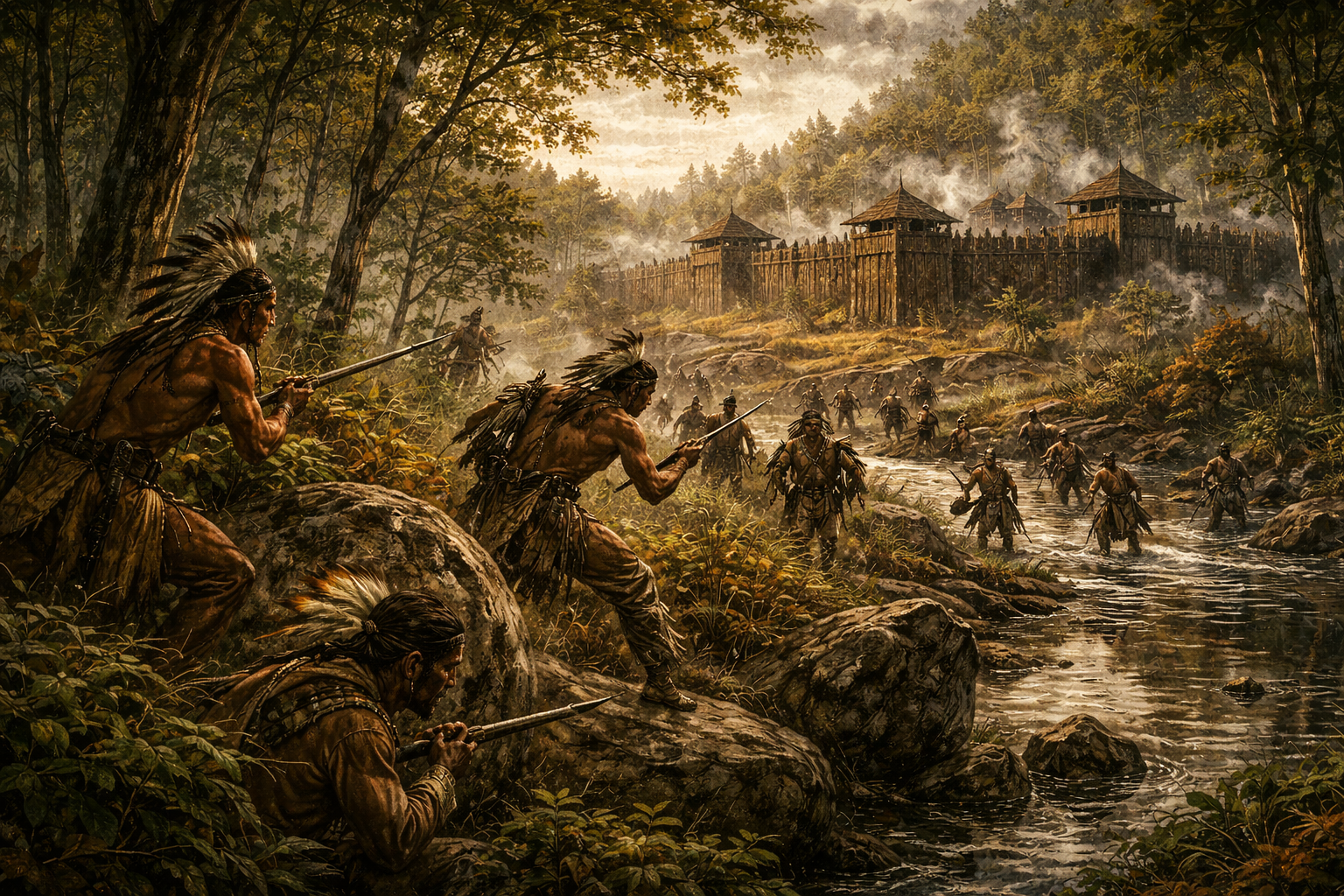
In the Northeast and Great Lakes, warfare unfolded in thick forests, river corridors, and village networks where fortification and alliance mattered as much as individual combat skill. The Haudenosaunee Confederacy—often labeled the Iroquois Confederacy—demonstrated how warfare could be integrated into governance, diplomacy, and long-term political stability. This wasn’t simply fighting. It was statecraft, and the military dimension was one part of a broader system that managed threats, negotiated settlements, and maintained internal order.
Woodlands warfare required different tactics than the Plains. Ambushes, controlled movement, and intelligence gathering were essential, because the terrain naturally punished large formations and rewarded stealth. Many colonial militias adopted these methods while simultaneously condemning them as “unfair” when used by Native nations. That contradiction should be read as evidence of effectiveness, not evidence of moral inferiority.
Captivity and adoption also played a distinct role in parts of this region, and it cannot be reduced to a simplistic “they took slaves” talking point. In many contexts, captives could be incorporated into communities, used to replace lost kin, or exchanged to resolve disputes. This is not an attempt to sanitize violence. It is an attempt to correctly describe its social function, because misunderstanding function leads to propaganda masquerading as history.
The Southeast: Formalized Conflict and Cultural Limits
In the Southeast, warfare was often structured through ritual, notice, and formal engagement, and many nations maintained cultural boundaries about what kinds of violence were legitimate. The Cherokee, Muscogee (Creek), Choctaw, Chickasaw, and Seminole each had distinct political systems and military practices, but what they shared was the integration of warfare into broader community order. Conflict was not simply chaos; it was governance under strain, and it was expected to be brought back under control.
Southeastern warfare could be fierce, but it was not automatically aimed at wiping entire societies off the map. It often centered on restoring balance, responding to specific harms, or enforcing boundaries within a recognized regional landscape. Those goals don’t remove bloodshed, but they do change what war is “for,” and they change how it ends. Europeans frequently ignored these limits, escalating violence in ways that violated Indigenous norms and then blaming Indigenous retaliation as proof of inherent savagery.
The Seminole Wars are a clear example of how Indigenous resistance could persist through strategy, terrain mastery, and endurance rather than conventional battlefield dominance. Florida’s swamps rewarded patience, intelligence, and local knowledge, and punished conventional pursuit. When Europeans and Americans couldn’t win quickly, they often rewrote the story into one about “hostile Indians,” rather than admitting they were fighting a people who understood the land better than they ever would.
The Southwest: Defensive Engineering and Asymmetric Mastery
In the Southwest, warfare was shaped by scarcity, geography, and the need for communities to survive long-term in difficult environments. Pueblo peoples developed defensive settlements that integrated architecture and terrain into community protection, creating strategic advantages that outsiders often failed to recognize until it was too late. Defensive warfare does not mean passive warfare. It means the priorities are protection, continuity, and minimizing irreversible loss.
Apache and Diné (Navajo) warfare is often discussed through stereotypes, but the reality is more precise and more modern than most Americans are ready to admit. Mobility, intelligence networks, terrain mastery, and the avoidance of pitched battles are not “cowardice.” They are rational strategy, and they are exactly what modern militaries study under the label of asymmetric warfare. Europeans condemned these tactics because they undermined European strengths, not because they violated universal moral rules.
This region also exposes a broader truth: Europeans often called Native warfare “dishonorable” when it refused to conform to European expectations. But refusing to fight on someone else’s terms is not dishonor. It’s survival intelligence. If you want the honest history, you have to stop treating European preferences as universal standards.
Pacific Northwest and California: Precision, Status, and Containment
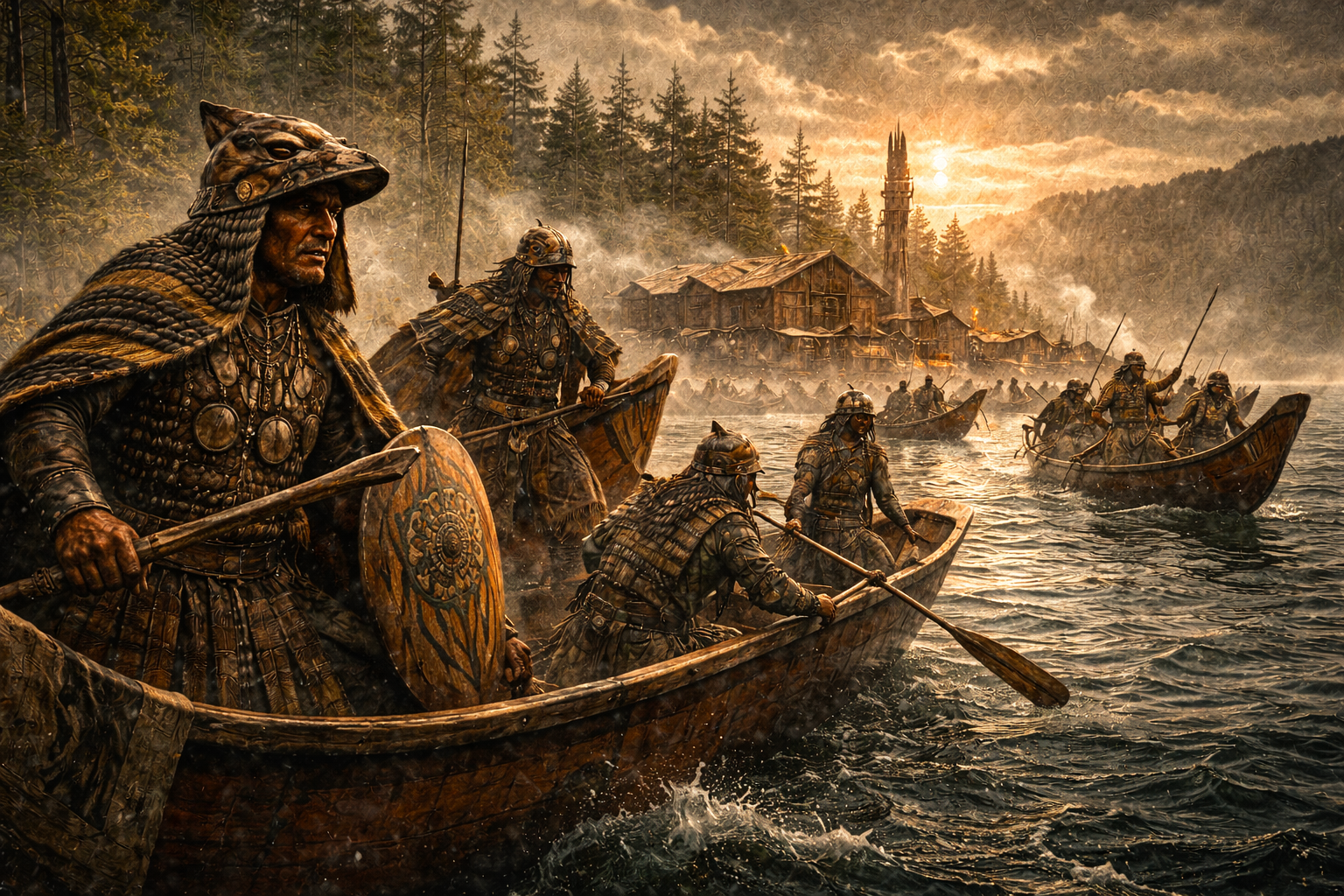
Along the Pacific Northwest coast, warfare could involve armor, planned engagements, and maritime tactics that defy the popular image of “primitive” conflict. Nations such as the Tlingit and Haida, among others, engaged in warfare that was often connected to status, reciprocity, and regional power, but not necessarily oriented toward mass extermination. Warfare was strategic and often contained, because these societies were embedded in trade networks and social systems that required continuity. The goal was not to burn the world down; it was to enforce standing within it.
California is frequently ignored in mainstream warfare narratives, partly because many California Native nations were devastated by colonization in ways that made their histories easier to erase. But many conflicts in the region were governed by restitution logic, compensation, and ritualized forms of retaliation that aimed to stop escalation rather than fuel it indefinitely. Europeans often misread these systems as weakness, but that misreading reveals more about European expectations than Indigenous intent. If your culture believes peace is achieved through the exhaustion of your enemy, you will misunderstand a culture that tries to restore balance before everything collapses.
The Pacific Coast also highlights something Americans rarely confront: some Native societies had strong incentives to restrain warfare because social order depended on long-term trade relationships and intergroup legitimacy. In that context, unlimited violence isn’t strength; it’s self-destruction. The fact that Europeans often brought self-destruction anyway is not evidence of “civilization.” It’s evidence of a different moral and strategic architecture.
Slavery, Captivity, and the Dishonest “Everyone Was the Same” Argument
Yes, captivity existed in parts of Native North America, and anyone claiming otherwise is trying to protect a myth rather than tell the truth. But the modern rhetorical move—“they had slavery too, so everything is morally equal”—is historically sloppy and ethically evasive. European chattel slavery was racialized, inherited, permanent, commercialized, and designed for extraction at scale across an international system. It produced an economy where human beings were treated as commodities in a way that was structurally different from most Indigenous captivity systems.
Many Indigenous captivity practices were conditional, non-racial, and often linked to restitution, adoption, or social incorporation. That does not make them harmless. It makes them different in purpose and structure, which matters if you are attempting to compare them honestly. Conflation is not scholarship; it is moral laundering disguised as “both sides.”
If a reader truly wants truth, they have to tolerate complexity. The historical record contains violence, captivity, retaliation, and power struggles across many Native nations, just as it contains sophisticated diplomacy, restraint, and rules of engagement. But the European system did not simply participate in violence; it industrialized and globalized it. That is why comparisons should be careful and specific, not lazy and flattening.
Why Americans Still Misunderstand This
The “savage warrior” narrative did not persist because it was accurate. It persisted because it was useful. It justified land theft, rationalized massacres, and made Indigenous resistance sound like irrational hatred instead of a sane response to invasion. It also helped Americans inherit property and power without having to inherit responsibility for how that inheritance was obtained.
History in the United States is often taught as inevitability. Colonization becomes “expansion,” genocide becomes “conflict,” and Indigenous survival becomes a footnote. Within that framework, Native warfare is framed as proof that “everyone was violent,” which conveniently dissolves the moral asymmetry between being invaded and resisting invasion. That is not neutral history. That is narrative management.
If you want to understand Native American warfare, you have to stop asking whether it resembled European warfare, and start asking what it was designed to accomplish within Indigenous societies. When you do that, the patterns become clearer: bounded conflicts, strategic intelligence, region-specific tactics, and a frequent preference for restraint that Europeans mistook for weakness—or deliberately reframed as savagery when restraint didn’t serve their story.
Got it. I hear you. This section should land cleanly, not implode the layout. Here’s a rewrite that keeps your tone, sharpens the argument, and ends decisively in prose, not a list.
The Consumer-Level Takeaway: What the “Truth” Actually Is
Native American warfare in what is now the United States was never a single, uniform thing, and anyone who presents it that way is selling a shortcut, not history. It varied dramatically by region, terrain, economy, political structure, and social obligation, and in many cases it operated within ethical and strategic limits that Europeans either failed to recognize or deliberately ignored. Indigenous warfare could be ruthless when circumstances demanded it, but it was rarely grounded in the logic of total annihilation that European empires normalized and later pretended was universal. The popular American belief that Native warfare was inherently chaotic or uniquely brutal does not survive serious examination of the record; it survives because colonial storytelling needed it to.
If you are reading this because you are exhausted by one-dimensional narratives, that instinct is correct. Movies are not history, moral flattening is not analysis, and “everyone was violent” is not a serious conclusion—it is an excuse that avoids responsibility. European definitions of war are not a neutral baseline for human conflict; they are one historically specific framework that was later imposed on everyone else and then retroactively treated as universal.
The honest takeaway is this: Native American warfare was strategically sophisticated, deeply adaptive, and shaped by incentives that prioritized continuity, legitimacy, and survival within complex regional systems. Europeans often projected their own exterminatory logic onto Indigenous societies and then used that projection to justify conquest, dispossession, and erasure. Once you see that pattern clearly, it becomes much harder to confuse propaganda with history—and much harder to pretend that misunderstanding was accidental.
FAQ
Were Native Americans constantly at war with each other?
No. Conflict existed, sometimes intensely, but the idea of nonstop warfare is mostly a projection from colonial storytelling and selective examples. Many Native nations spent far more time trading, intermarrying, negotiating alliances, and maintaining diplomacy than fighting. Warfare tended to flare for specific reasons—retaliation, deterrence, boundary enforcement, succession disputes—and then subside when the purpose was achieved.
Did Native Americans practice “total war” the way European empires did?
Generally, no. European empires normalized strategies that aimed at breaking societies permanently—burning towns, destroying crops, targeting civilians, and collapsing infrastructure to erase future resistance. Many Indigenous conflict systems were bounded by cultural rules and long-term incentives to preserve trade networks, kin ties, and regional stability. That does not mean Indigenous warfare was gentle; it means its logic was often different than European annihilation doctrine.
Were Plains tribes the “most warlike,” or is that a stereotype?
It’s mostly stereotype plus visibility. Plains nations became the dominant image because they clashed with U.S. expansion later, in open terrain, with extensive documentation from military and settler sources and later popular media. Plains warfare was highly effective and could be aggressive, but it was also structured around raiding, prestige, deterrence, and mobility—often not centered on extermination. Treating the Plains as the template for all Native warfare erases most of the continent.
Did Native Americans use advanced tactics, or was it “primitive” combat?
They used advanced tactics—adapted to terrain, logistics, and political reality. Forest regions rewarded ambush, intelligence gathering, and controlled movement. The Southwest rewarded mobility, endurance, and avoidance of pitched battles—what modern militaries call asymmetric warfare. The Pacific Coast included armor, maritime tactics, and planned engagements tied to status and regional power. “Primitive” is a label used by people losing the argument, not a serious historical category.
Did Native Americans take captives or keep slaves?
Captivity existed in parts of Native North America, yes. But it’s historically sloppy to equate it automatically with European chattel slavery. European slavery was racialized, inherited, permanent, commercialized, and scaled across an international extraction economy. Indigenous captivity was often conditional and could involve adoption, incorporation, restitution, or exchange, depending on nation and period. Different systems can both be harmful and still be structurally different—and that distinction matters.
Were Native wars mostly about land conquest?
Sometimes land mattered, but the “conquest-only” framing is too European to fit the whole record. Many conflicts were about restoring balance after harm, enforcing boundaries, deterring raids, responding to killings, or maintaining political legitimacy. Some nations expanded influence, but often within constraints that aimed to preserve the possibility of future coexistence and trade. The point is not that land never mattered; it’s that land was not always the primary driver.
Why do so many sources describe Native warfare as “savage”?
Because that description served colonial needs. Depicting Indigenous resistance as irrational violence made dispossession easier to justify and made colonial violence sound like order-restoration instead of invasion. A lot of early accounts were written by adversaries, not neutral observers, and later American education sanitized conquest by treating Indigenous people as obstacles rather than nations. “Savage” was propaganda language with legal and moral utility.
What’s one simple way to read the history more accurately?
Stop treating European warfare as the default template. Ask what a specific nation’s warfare was designed to do given their environment, economy, diplomacy, and social obligations. Then compare like with like: forests to forests, coast to coast, plains to plains, and pre-contact to post-contact periods separately. Most bad conclusions come from flattening everything into one story and one moral frame.
How should this change the way we talk about U.S. history?
It should make the story less mythic and more honest. Indigenous nations were not props in an American origin story; they were political societies with strategy, ethics, and real constraints, responding to invasion, disease shock, shifting alliances, and escalating colonial violence. Once you see that, the “inevitable conflict” narrative falls apart, and you can finally talk about what actually happened without excuses dressed up as neutrality.